Hi
VA3GY
Amateur radio has been a big part of my life, especially with the use of ham radio equipment for VHF/UHF operation.
Amateur Radio: My Journey
Born in Canada and having lived in South Africa and Scotland for most of my life, I am now settled back in Canada.
My Hobby
My interest in amateur radio began at the age of 12 when I was introduced to the hobby by Iain McHardy GM3JFG, who has since become a Silent Key.
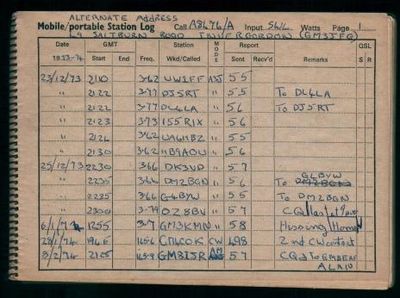
I was a SWL with the RSGB issued designation A8476 between 1973 and 1978.
I first received my amateur radio license in 1978 as GM4GUQ while living on the Black Isle in the North of Scotland, later moving to Inverness.
As GM4GUQ, my main focus was on VHF/UHF operation, and I also enjoyed a great deal of mobile operation. Another aspect of the hobby I found particularly exciting was working with ham radio equipment for Fast Scan TV. Several of us were equipped with 23cms FM equipment, and we would participate in RAYNET exercises, using this mode to send pictures back to the control of whatever event we were covering.
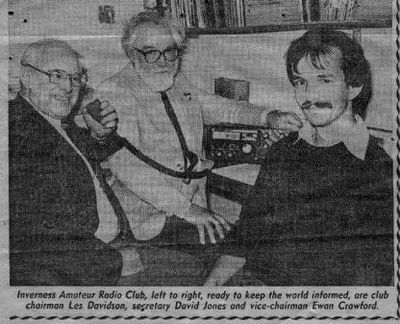
I was a member of the Inverness Amateur Radio Club, which I heard recently has folded due to a lack of membership. However, in the 80s, the IARC was quite active, and we operated a station during most field days and VHF/UHF contests.
Additionally, I was involved in the local repeater group, serving as the Technical Manager for the GB3BI repeater. Established in 1985 at a height of 1000 ft/asl, this repeater provided impressive coverage across the North of Scotland.

Station Equipment
My very first contact was made with GM3JFG on a Green and Douglas AM transmitter, using a G2DAF receiver along with a Microwave Modules 2 meter receive converter. Following that initial experience, I explored various amateur radio setups over time, which included the following ham radio equipment:
- FT200 (HF SSB/CW)
- FT101ZD (HF All Mode)
- FT77 (HF All Mode)
- NEC P2200E (2m FM Xtal - and a piece of junk)
- IC202 (2m SSB VXO)
- FT290R (2m All Mode)
- TR2200 (2m FM Xtal)
- FT411 (2m Handheld)
In addition, I also had an assortment of Microwave Modules linears and transverters for VHF/UHF operation.
Location
When we moved to Canada in 1990, I sold everything. That year, my XYL and I decided to relocate to Ontario. During the early 90s, I wasn't active in amateur radio due to the pressures of work and raising a young family. It wasn't until we moved to Saint John, New Brunswick in 1995 that I found the time to resume my hobby and got back on the air as VE9ECC. I was quite active on the HF bands since there was very little VHF/UHF operation in the Maritimes. In 1999, we moved back to Ontario, and I took the callsign VA3ECC. In May 2002, I changed my Ontario callsign from VA3ECC to VA3GY.
Interests
My primary interests in amateur radio include VHF/UHF SSB operation. I was really excited about the possibility of working AO-40, but its post-launch problems have made that difficult. In the 80s, I was also quite active in 23cms Fast Scan TV. Moreover, I enjoy participating in the local ARES group (Amateur Radio Emergency Service), as I was involved in a similar RAYNET group in Scotland.